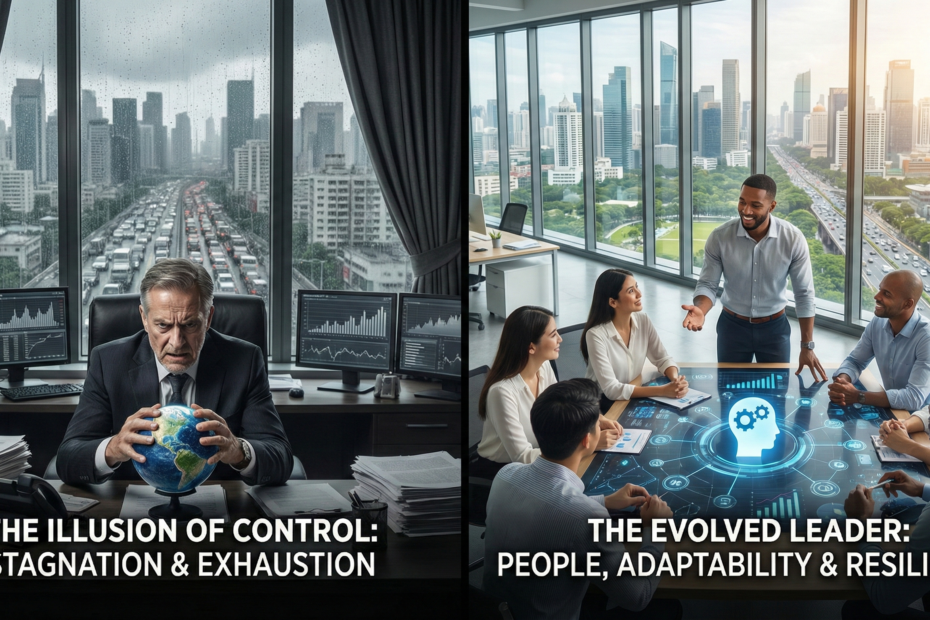
And Why Investing in Your People Is the Only Strategy That Holds in Volatile Times
There’s a quiet, often unspoken grief running through today’s corporate world.
It’s not just burnout.
It’s not lack of skill.
It’s the collapse of predictability; a belief system that once held the professional world together.
For decades, many employees operated under an implicit psychological contract: ‘If I work hard, I’ll be rewarded. If I stay loyal, I’ll be protected. If I perform, I’ll be safe.’
But the last fifteen years have revealed a harder truth: much of what people believed they controlled was never truly theirs.
In boardrooms and factory floors alike, leaders watched markets shift faster than their plans could keep up. Customers changed behaviors overnight. Technologies evolved in cycles so short that long-term strategic plans (once considered sacred) now rarely survive their first encounter with reality.
And the shock isn’t only external.
Many executives still cling to outdated assumptions:
- that their experience immunizes them from disruption,
- that loyalty guarantees stability,
- that the strategy they crafted last year is still relevant today,
- that the competition will play by the same rules,
- that geopolitical shifts won’t reach their supply chains, client base, or margins.
But reality keeps reminding us otherwise.
Blockbuster was a $6 billion giant convinced people wanted the familiar Friday-night store visit… until Netflix proved the world had discovered and preferred convenience.
Nokia dominated global mobile phones yet underestimated the speed of smartphone OS innovation… and fell from 48% market share to complete irrelevance in only five years.
Airbnb entered hospitality during a global recession and a risk-averse environment, precisely when hotels believed consumer loyalty would shield them. It didn’t.
Kodak was a 130-year industry icon that once controlled nearly 90% of the U.S. film market… and yet collapsed because in a deliberate effort to avoid self-cannibalization and self-disruption, it chose not to adapt to the very digital technology it invented. Ironic anyone?
These examples are famous not because big companies failed, but because the world changed and their strategy didn’t.
And yet the most underestimated factor in all these collapses wasn’t technology. It wasn’t competition. It wasn’t regulation.
It was human behavior inside the company… ego, rigidity, silos, denial, slow cultural adaptation, internal team battles, unspoken fears, and the inability to redesign thinking patterns when the environment demanded it.
As baffling as it may sound, even in 2025 many organizations still rely on linear, brittle planning while operating in a nonlinear, volatile world.
The truth is that strategy cycles get shorter, customer sentiment flips without warning, geopolitical uncertainty bleeds into every industry, and artificial intelligence is rewriting value chains at speeds leaders can barely process.
So no, teams aren’t failing because they lack skills. They’re failing because the illusion of control has shattered. And once that illusion crumbles, individuals, teams, and entire organizations face the same question: ‘If the world is changing faster than we can predict… what exactly is still in our control?’
This is the purpose of the Re-Thrivin’™ Circle of Control framework, not as a motivational poster, but as a strategic, psychological, and cultural foundation for organizational resilience.
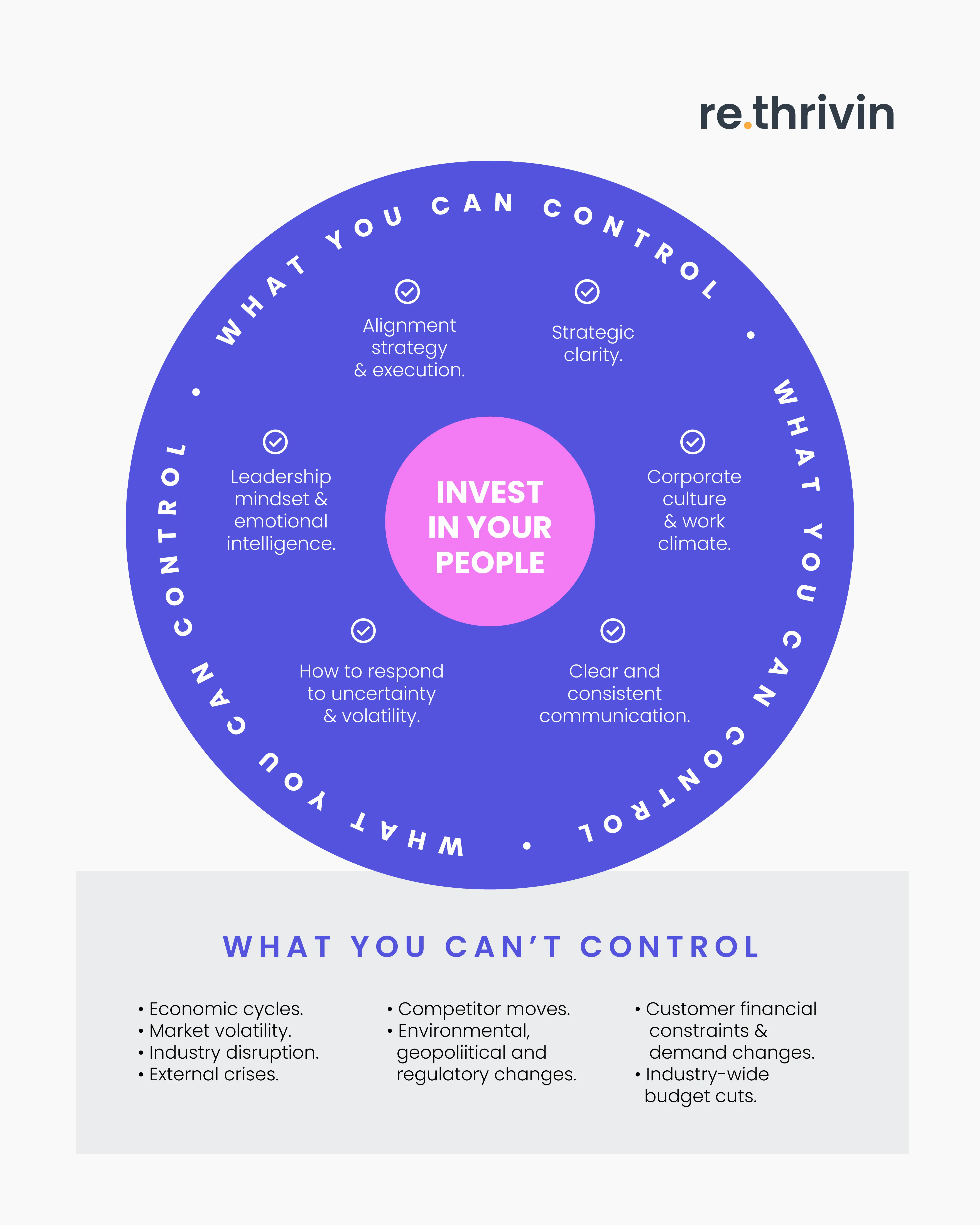
What You Cannot Control: The Outer Circle
Let’s face it: Every year, countless hours, millions of dollars, and enormous emotional energy are wasted because entire companies (executives, teams, and boards) are anxiously trying to control forces that were never in their control to begin with.
That anxiety pulls focus inward, drains creativity, fractures collaboration, and creates a false sense of productivity, when in reality… it’s movement without advancement. A spiral. And it’s understandable: the world is moving at dizzying speeds, markets contract and expand unpredictably, technologies evolve by the quarter, customer expectations shift overnight, AI rewrites entire industries in months, not years. And if it wasn’t enough, geopolitical tensions seep into supply chains, pricing, and demand. Leaders are expected to adapt instantly to realities no strategic plan had predicted.
In that environment, grasping for control feels natural, but it’s also the fastest path to exhaustion.
Because the truth is: a huge portion of what shapes business outcomes today sits far beyond any leader’s reach.
- Market volatility
- Economic cycles
- Industry disruption
- Competitor moves
- Industry-wide budget cuts
- Environmental, geopolitical, and regulatory shifts
- Customer financial constraints & rapid demand changes
- External crises
Harvard research shows that leaders consistently underestimate the role of randomness in business outcomes and overestimate their ability to stabilize unpredictable environments.
Wharton studies similarly note that uncertainty is now a permanent structural feature, not an interruption.
We can prepare for these forces. We can anticipate, scenario-plan, and strengthen our resilience.
But we cannot eliminate them.
This is the psychological shift that separates reactive organizations from resilient ones:
moving from ‘control everything’ to’ respond wisely to what cannot be controlled’.
And this isn’t just academic. I lived it.
For years, in my manufacturing company, I tried to hold onto every variable: client volatility, supplier delays, market pricing, political risk, regulatory changes, even the emotional weather inside the leadership team. As a 34-year-old female CEO leading a 450+-person organization, I carried all of it as if it were my personal responsibility to stabilize the entire system.
When the exchange rate fluctuated, I lost sleep. When a client delayed a purchase order, I saw it as a failure. When a supplier fell behind, I absorbed the pressure myself. I was managing storms I couldn’t stop, instead of strengthening the structures inside the company that actually made us adaptable.
That’s what shocked me years later: most of the suffering, mine and my company’s , didn’t come from the events themselves, but from the belief that I had to control what was uncontrollable.
It drained my health, my focus, my creativity. It drained my executives too. What I didn’t see at the time was that my job was never to fight the waves… au contraire, my role was to build a team and shape a culture able to rise with them. A team that could absorb the unexpected, adjust with agility, strengthen through adversity, and trust each other enough to learn, adapt, and evolve together. A true high-performance organism, not by title but by spirit.
The outer circle matters not because we cannot change it, but because acknowledging its uncontrollability frees us to focus on what actually moves the needle: the inner levers of alignment, culture, behavior, adaptability, clarity, communication, and leadership.
Once leaders make this psychological shift, everything changes.
What You Can Control: The Leadership Ring
Inside all that turbulence lies the one sphere leaders can shape, and it is here where real organizational evolution begins.
Strategic clarity
Strategic clarity is not having a perfect five-year plan. It’s the ability to name priorities, make trade-offs, give direction, and protect attention when the external world is noisy. MIT Sloan research highlights that clarity of direction is one of the strongest predictors of organizational resilience.
Alignment between strategy & execution
Strategy dies where alignment breaks. Studies from the Boston Consulting Group show that organizations with high alignment between strategy and execution outperform their direct competitors and comparable companies even when the economy is bad. This alignment isn’t abstract — it’s the hard wiring of the organization: incentives that reinforce the same goals, decision rights that remove friction, priorities that don’t contradict each other, and KPIs that pull people in one direction instead of competing for attention. When these elements are misaligned, execution collapses. When they are coherent, organizations accelerate. Fixing this is entirely within leadership control.
Clear, consistent communication
The biggest myth in corporate life is that saying something means it was understood. Leaders talk; teams interpret. And interpretation is shaped by anxiety, past experiences, organizational politics, and personal insecurity. This is why world-class leadership requires relentless clarity: repeating key messages, validating understanding, and closing the meaning-gap before it derails execution. Harvard research on psychological safety finds that transparency, context-sharing, and consistent communication reduce anxiety, increase trust, and strengthen collaboration.
How you respond to uncertainty & volatility
Organizations don’t break from uncertainty; they break from poor responses to uncertainty.
Leaders influence whether teams default to panic, denial, or adaptive problem-solving. Research from Wharton on decision-making under ambiguity shows that teams perform better when leaders frame uncertainty as experimentation, not threat.
Leadership mindset & emotional intelligence
INSEAD and Stanford research emphasize that during volatility, the most stabilizing force in an organization is not processes, it’s leader emotional maturity. Markets may be unpredictable, but people become steady when their leader is steady. This psychological anchoring is what separates high-performing cultures from anxious ones.
Emotional intelligence is not a ‘soft skill’. It is structural power; the stabilizing force that determines whether an organization fractures or evolves.
A leader’s inner world becomes the weather system the team works inside.
Powerful emotional maturity includes the ability to:
- Recognize personal triggers under stress, rather than letting old patterns (fear, defensiveness, control) run the meeting.
- Regulate your own emotional state, understanding that your nervous system sets the emotional temperature for everyone else.
- Not transmit anxiety downward, because panic is contagious… but so is calm.
- Stay relational during tension, holding connection even when conversations get hard.
- Hold ambiguity without collapsing into rigidity, impulsiveness, or avoidance, the three classic derailers of senior leadership.
But emotional maturity expands beyond the self.
It includes empathy and attunement: the capacity to tune into others, understand their emotional signals, and respond in ways that reduce fear and increase clarity. Empathy is not indulgence; it’s data. It tells you what your people cannot say out loud, what they are afraid to ask, and where the hidden resistance sits.
High-empathy leaders can:
- Sense when someone is overwhelmed before their performance drops.
- Detect brewing conflict before it explodes.
- Hear the need behind the complaint.
- See the human behind the behavior.
And then there is co-regulation, one of the most underestimated capacities of executive leadership. Teams borrow emotional stability from their leader. When a leader slows their breath, grounds themselves, and stays present, the team does too.
A leader with emotional maturity can:
- Absorb pressure without amplifying it.
- Redirect collective anxiety into productive effort.
- Reframe fear into solvable problems.
- Model resilience, which becomes the template the team imitates.
- Activate creativity by reducing psychological threat.
- Build a culture where people can breathe, think, and innovate, instead of merely survive.
This is the difference between a boss who manages tasks, and a true leader who regulates the emotional ecosystem of the company:
One creates compliance. The other builds coherence.
One exhausts people. The other elevates them.
One demands obedience. The other cultivates commitment, courage, and contribution.
This is psychodynamic leadership in practice: the discipline of managing the inner architecture that shapes outer performance. And this capacity is 100% within a leader’s control.
And this is the heart of Re-Thrivin’: transforming leaders so they can transform their teams.
Corporate culture & work climate
Peter Drucker’s famous line “Culture eats strategy for breakfast” has been validated repeatedly across organizational science. Google’s Project Aristotle, Harvard research on psychological safety, and INSEAD studies on team dynamics all converge on the same truth: Culture is the ultimate multiplier, or eroder, of performance. It is the determining force behind whether strategy lives or dies.
And culture is not abstract. It is not posters on a wall or a list of values in a PowerPoint. Culture is the felt sense of an organization; the emotional climate people work inside every day.
INSEAD’s Sumantra Ghoshal famously described culture as “the smell of the place”: the invisible atmosphere that tells people whether they can grow, take risks, speak up, collaborate, or whether they must shrink, self-protect, or stay silent. His metaphor has endured because it captures what leaders often overlook: people don’t respond to strategy documents; they respond to the emotional environment they breathe in daily.
And here is the part that matters most: This sphere is yours. Entirely. Culture is developed by what leaders do daily, not by external events. Culture is the inner architecture of the organization. A leader’s behavior is the blueprint.
A few years ago, during one of the most volatile seasons in my company, I learned this lesson the hard way.
Supply chains were collapsing, client demand was surging, and pressure was hitting us from every angle. My leadership team wasn’t failing, they were fracturing. Meetings spiraled into defensiveness, departments pushed blame sideways, and real problems were hidden until they exploded.
I kept assuming it was execution “We need better planning, better forecasting, better follow-up.” Then, in a tense leadership meeting, a senior manager said something that froze the room: “I’m not afraid of the problems, but I’m very tired. And mostly I’m tired of how we treat each other when things go wrong. Particularly the way you lead us through storms Yuri.”
In that moment, everything snapped into focus. It wasn’t the market. It wasn’t the economy. It wasn’t our capacity. It was theculture we had created under pressure.
People were in survival mode: guarded, reactive, territorial. And without realizing it, I had set the tone: speed over reflection, outcomes over transparency, firefighting over learning. That day, I made two different decisions: We would fix the work climate we worked in. And I would transform my leadership style.
After that moment, I committed to doing the real work, the inner work. I went through my own executive coaching and change-management process, unlearning the reflexes that were no longer serving me and relearning what true leadership required. It wasn’t easy, and it wasn’t painless, but it was necessary.
And slowly, the company began to shift.
Six months later, meetings were sharper, trust was growing again, and people were taking risks, collaborating, and challenging each other with far more courage. The cultural climate was different… lighter, steadier, braver.
After one particularly strong meeting, I asked my COO what he thought had changed. He smiled and said, “YOU changed, Yuri.”
The Core: INVEST IN YOUR PEOPLE
At the center of the Re-Thrivin’™ Circle of Control framework, is the truth every resilient organization eventually discovers: your people are your only sustainable advantage.
Inside that core are the five behavioral pillars that shape a future-ready, psychologically mature, high-performance workforce:
• Adaptability: Teams adjust quickly because they aren’t punished for changing course.
• Accountability: Ownership is distributed, expectations are clear, and trust flows in every direction.
• Continuous Learning: Mistakes become data; iteration becomes normal; curiosity becomes contagious.
• Resilience: People recover, integrate, and reset; instead of burning out under pressure.
• Purpose: Individuals understand the “why,” making difficult decisions coherent rather than chaotic.
These pillars are not static images on the wall. They are direct predictors of capacity, innovation, and long-term value creation.
McKinsey, Deloitte, and Harvard research converge on the same finding: organizations that invest deliberately in human development consistently outperform those that treat people as cost centers, particularly during uncertainty.
You cannot control the storm. But you can absolutely strengthen the people navigating it.
Leadership is not the art of taming the uncontrollable. It is the discipline of mastering what is truly ours.
References
Uncertainty, Volatility & the Limits of Control
Harvard Business School – Role of Randomness
Liu, F., & Tsang, A. (2021). Randomness in organizational outcomes. Harvard Business School Publishing.
Wharton – Uncertainty as Structural, Not Episodic
Guler, I. (2020). Decision-making under uncertainty. Wharton School of the University of Pennsylvania.
MIT Sloan – Strategic Clarity & Organizational Resilience
Ritter, J., & Andersen, T. J. (2014). Managing in turbulent times: The value of strategic clarity. MIT Sloan Management Review.
Strategy, Alignment & Execution
Boston Consulting Group – Strategy-Execution Alignment
BCG. (2020). The execution alignment advantage: Why coherence outperforms complexity. Boston Consulting Group Research.
McKinsey – Organizational Health & Performance
Keller, S., & Price, C. (2011). Beyond Performance: How Great Organizations Build Ultimate Competitive Advantage. McKinsey & Company.
On Leadership Psychology, Emotional Intelligence & Behavior
INSEAD – Leadership Emotional Maturity
Kets de Vries, M. F. R. (2014). Mindful leadership coaching. INSEAD Global Leadership Centre.
Stanford – Emotion Regulation in Leadership
Gross, J. J. (2015). Emotion regulation: Current status and future directions. Stanford University Research Program in Affective Science.
Harvard – Psychological Safety & Communication
Edmondson, A. (2019). The Fearless Organization: Creating Psychological Safety in the Workplace for Learning, Innovation, and Growth. Harvard Business Publishing.
On Culture, Teams & Organizational Climate
Google Project Aristotle – What Makes Teams Effective
Rozovsky, J. (2015). The five keys to a successful Google team. Google Re:Work.
Peter Drucker – Culture Eats Strategy
Drucker, P. (2001). Management Challenges for the 21st Century. HarperCollins.
INSEAD – “The Smell of the Place”
Ghoshal, S. (1995). The smell of the place: Organizational context and human behavior. INSEAD.
On Human Development, Talent & Long-Term Value
McKinsey – Human Capital as Competitive Advantage
McKinsey Global Institute. (2020). The future of work: Human capital and resilience.
Deloitte – The Social Enterprise & Human Maturity
Deloitte Insights. (2021). 2021 Global Human Capital Trends: The social enterprise in a world disrupted.
Harvard – Purpose, Resilience, Learning & Performance
Ranjay Gulati. (2022). Deep Purpose: The Heart and Soul of High-Performance Companies. Harvard Business Review Press.
Business Case Studies Referenced
Netflix vs. Blockbuster
Randall, B. (2019). The rise of Netflix and the fall of Blockbuster. Business Case Journal.
Nokia Collapse
Doz, Y., & Wilson, K. (2018). Ringtone: Exploring the Rise and Fall of Nokia. Oxford University Press.
Kodak & Digital Disruption
Lucas, H. C., & Goh, J. (2009). Disruptive technology: How Kodak missed the digital photography revolution. Journal of Strategic Information Systems.
Airbnb in Recession
Guttentag, D. (2015). Airbnb: Disruptive innovation and the rise of the informal tourism accommodation sector. Current Issues in Tourism.